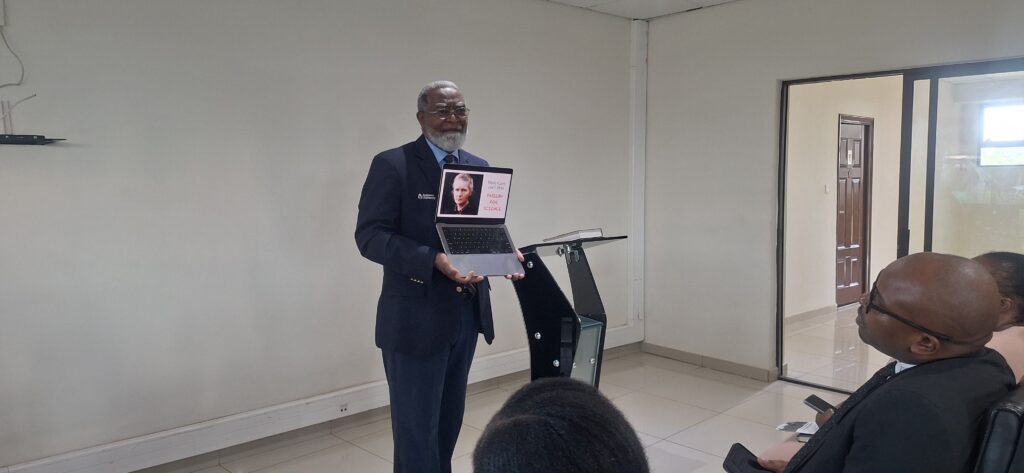
The second devotional message—presented by Dr Pardon Mwansa—called leaders and members to reflect deeply on the transformative power of vision. Building on the earlier message that explored spiritual passion and burden, this session focused on a critical question: What happens when God’s people clearly understand what He has called them to do?
The answer is simple yet profound—clarity produces movement, unity, and accomplishment.
Vision Rooted in Spiritual Burden
The message continued the reflection on the experience of Nehemiah, whose heart was stirred when he learned of Jerusalem’s broken walls. His response was not passive concern but purposeful action. After prayer, reflection, and dependence on God, he articulated a simple but compelling vision:
“Come, let us rebuild the walls… and we will no longer be in disgrace.”–Nehemiah 1:17
This was not a vague aspiration. It was specific, measurable, and compelling. Because the vision was clear, the people understood their task, and the rebuilding was completed in just 52 days.
The lesson is unmistakable:
When God’s assignment is clearly defined, His people are empowered to act decisively.
God’s Pattern: Clear Vision, Decisive Action
Scripture consistently reveals that God works through clearly defined mission statements.
When God spoke about delivering Israel from Egypt, His purpose was unmistakable: to rescue His people and bring them into a land flowing with milk and honey. Moses did not operate in uncertainty. He knew precisely what God intended—and divine power accompanied the mission.
Similarly, Christ’s Great Commission outlines the church’s enduring mandate: make disciples, teach obedience, and proclaim truth to all nations. This is why the guiding emphasis—“Grounded in the Bible, Focused on Mission”—captures the essence of Christian identity. The mission is already revealed; faithfulness lies in executing it.
The Historical Identity of a Movement
The devotional also traced the historical emergence of the Seventh-day Adventist Church, reminding listeners that the movement itself was born from a clearly defined prophetic conviction.
In the early nineteenth century, William Miller proclaimed with conviction that Christ’s return was imminent. Though his calculations were mistaken, the central conviction—that the Second Coming is a neglected but essential biblical doctrine—remained foundational.
This insight shaped a movement whose spiritual identity is inseparable from the proclamation of Christ’s return. To neglect this message would be to abandon the very DNA of the church.
Earlier in Christian history, reformers like Martin Luther challenged established structures and called believers back to biblical authority. Each renewal movement in history has been propelled by a clear and compelling vision.
Vision Beyond the Church: A Universal Principle
Vision is not only a theological concept—it is a universal principle of achievement.
Technology was transformed because Steve Jobs envisioned devices that were simple, beautiful, and accessible. Aviation history changed when Amelia Earhart pursued a world where women could break barriers in flight. Their accomplishments demonstrate that clearly defined goals mobilise extraordinary effort.
Even mission-oriented initiatives reflect this same principle. The global placement of Scripture in hotel rooms by Gideons International is the result of one straightforward vision—to make the Word of God accessible everywhere people travel.
In every domain—spiritual, social, or technological—clarity precedes accomplishment.
Vision at Every Level of Life
One of the most practical dimensions of the message was the recognition that vision operates at multiple levels:
- Personal life
- Family life
- Ministry or department
- Local congregation
- Institutional or union leadership
Without intentional direction, individuals and organisations drift into routine activity rather than a purposeful mission.
The challenge presented was deeply reflective:
- What is the vision of my life?
- What is the vision of my family?
- What is the vision of the ministry entrusted to me?
- What is the vision of the church community I serve?
Those who accomplish great things for God rarely move aimlessly. They prayerfully define their purpose and pursue it with discipline and faith.
A Call to Spiritual Deliberation
The devotional concluded with a solemn invitation to reflection. Just as Nehemiah discerned God’s burden and articulated a plan, believers today must prayerfully seek divine direction for their own spheres of influence.
Vision is not human ambition—it is a revealed purpose embraced through faith.
Where vision is clear, unity grows.
Where unity grows, action follows.
Where action aligns with God’s will, transformation occurs.
Many communities struggle not because they lack resources or devotion, but because they lack defined direction. Vision organises energy. Vision inspires sacrifice. Vision sustains perseverance.
Above all, vision honours God by treating His calling as specific, purposeful, and actionable.
The enduring question remains:
What vision has God entrusted to you—and how clearly have you defined it?